Kate Mieczkowska
A painter of large figurative oils, returning again and again to the question of who holds power and what its holding costs everybody else.
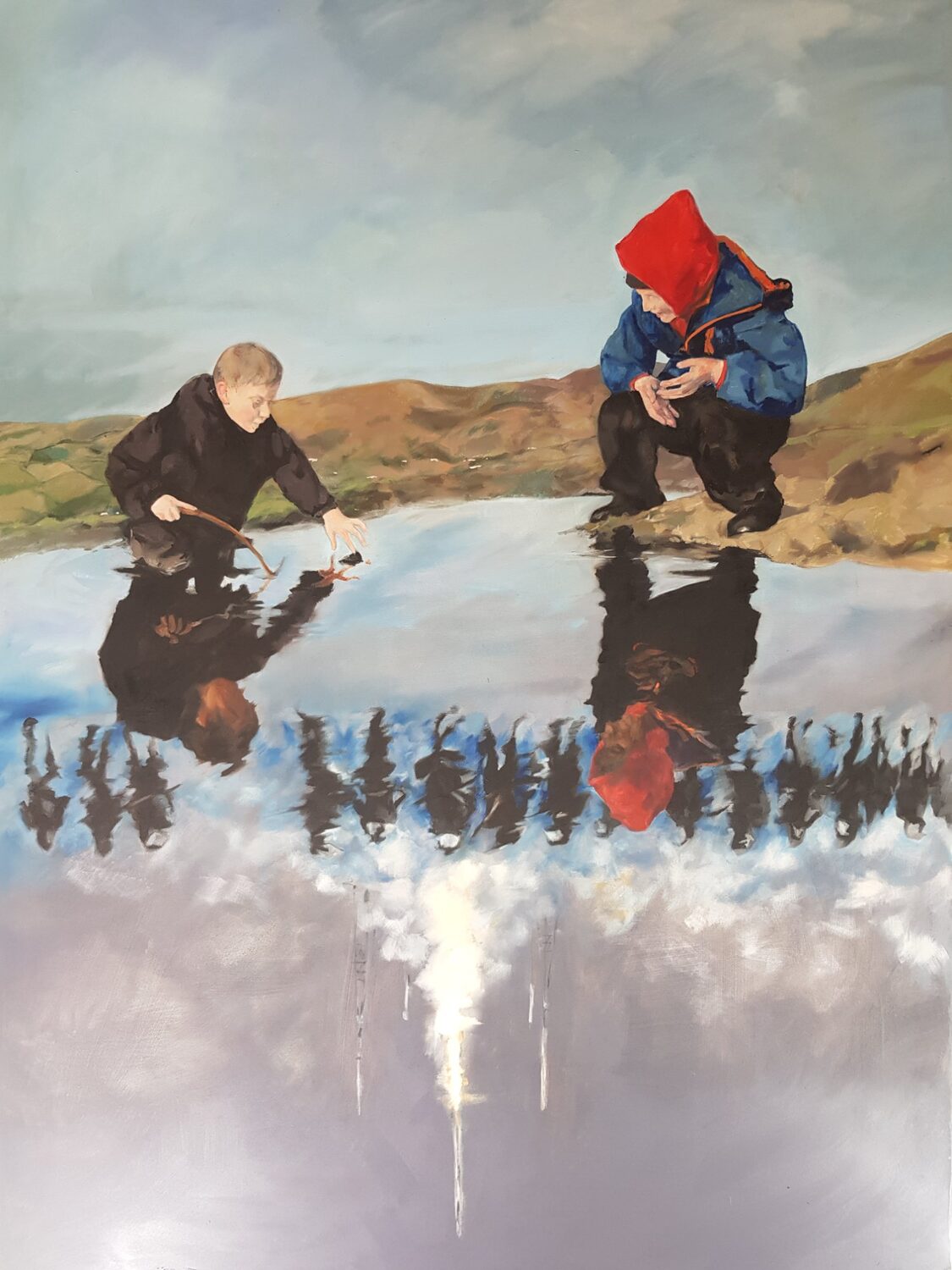
Over the Pond, oil on canvas, 244 × 183 cm, 2020. Shown in PATH, an independent exhibition in Venice during the 2024 Biennale.
I have always loved being in front of a big painting. It's like a duvet — it wraps around you, and you're lost in it.
Kate Mieczkowska has worked as a fine artist for over nineteen years. She is a trustee of an arts foundation and contributes to sustainability in the arts and culture.
As an Associate Artist at Chapel Arts Studios she contributes to community-focused programmes, including social prescribing projects for the NHS. Her work has been shown at the Royal Academy Summer Exhibition and in group exhibitions in Venice.
She took a first in Sculpture at Winchester School of Art in 2010 and an MA in Fine Art at Chelsea College of Arts in 2018. The paintings are built directly onto the canvas out of sketches and her own photographs rather than worked up from a finished drawing, and a sculptor's understanding of anatomy, human and animal alike, lets her put weight and movement into a figure quickly. The pictures depend on a tension she has no interest in resolving: passages of close observational realism set against areas of flat graphic colour that make no pretence of describing anything.
The subjects begin in ordinary life and turn strange while she is looking at them. A wrecked car on the A34. A great-aunt on a carousel. Armed officers at a funfair. A prizefighter leading in the colt that bought him his respectability. Peter Doig and Patrick Caulfield are the painters she keeps returning to; Louise Bourgeois, Mike Nelson and Joseph Beuys are the artists she met first, as a sculptor, and they have never entirely left the work. She lives and works in Hampshire.
Recent painting
2023–2026The work of the past three years has moved steadily closer to home, until the landscape being painted is the one immediately outside the studio. Hampshire is not a backdrop in these pictures so much as a participant, and the animals that have always moved through the work now graze in fields that can be named.
Andover Wins
John Gully fought his way out of a debtors' prison in 1805, took the Championship of England, and spent the remainder of a long life converting the proceeds into racehorses and, eventually, a seat in Parliament. The colt he leads here is Andover, trained by John Day at Danebury on the downs above the town and winner of the 1854 Derby, and Gully appears as he must have looked long before the respectability arrived, stripped to the waist and still carrying the marks of the ring. The stands on the skyline are the Danebury ones as they stand today, painted from life, so that the ruin belongs to the present and the two men do not, and the field holds both centuries at once without troubling to reconcile them. The stage backdrop for S for Freedom, below, was painted out of the same history.
Backdrop for S for Freedom
Painted as the stage backdrop for S for Freedom at the Chantry Centre, Andover, in January 2026, as part of New British Rural. A grey horse lies recumbent in a green field, and the picture refuses to settle whether it is dead or asleep. Behind it stands the quintessential English village: the church tower is St Mary's in Andover, and with it comes everything a church tower carries, convention, tradition, the long settled order of the place. Against that, an abandoned supermarket trolley and a horse on the ground. A skewbald grazes on by the wall, entirely untroubled, and a swift cuts the blue above them. The play draws on the same history as Andover Wins, above: Gully, the colt named for the town, and what the town made of both.
Dawn
A woman in a long evening dress stands at the edge of a green oval, her head bent over a glass she seems to have forgotten she is holding. A barn owl and a collapsed deckchair occupy the same lit ground beside her, and everything beyond that circle of green has gone to darkness. Whether the light is arriving or departing is left deliberately unsettled.
Socrates Classroom was under a Tree
A production of Romeo and Juliet by the Lord Chamberlain's Men on the Isle of Wight, painted from the far side of the field. The audience has brought camping chairs and put its umbrellas up against the weather, and the timber stage stands at the right with Juliet already on the balcony. Two thirds of the canvas is empty grass. The title comes from the observation that Socrates taught outdoors, and the painting is as interested in the field, the rain and the people who turned out in it as in anything happening on the stage. Selected for the Royal Academy Summer Exhibition in 2024.
A Requiem for Industry
Three wolves lie dead across the foreground while a hunter in First World War khaki stands among them, and behind him the century refuses to hold its order: an overturned car, a mother with her child, three nuns in wimples, and the London Eye turning above the treeline. None of it is taken from a place. The picture is wholly invented, assembled rather than observed, and it works as a requiem precisely because it gathers its mourners from wherever it likes.
A Season in Hell
Diptych, Watford Museum, 2021Two panels built on Rimbaud's Une Saison en Enfer, sharing a single ground: the same flat ochre field, the same storm coming in across a burning horizon, the same orange leaves blown through the foreground. Hung together, the pair reads as one landscape that has been interrupted rather than as two separate paintings.
A Season in Hell
A Viking longship burns on the ridge behind a rank of white flame, and three hyenas have the field to themselves, one lying, one standing watch, one with its head thrown back in what can only be laughter. An empty birdcage stands open at the left edge and a crown of thorns has been set down in a patch of blue at the right, two pieces of iconography left where they fell for the viewer to make of what they will.
A Season in Hell
Three men are arranged in the posture of a déjeuner: a youth crowned with poppies, a second in a brown coat glaring out of the picture at whoever is looking, and a bearded figure in black reclining with a cane, one hand extended in the middle of an argument we have arrived too late to follow. Bathers play in the middle distance, oblivious. On the horizon two oil fires stand straight up into the sunset, and a basket of fish and bread has been set down in the corner as though the picnic might still happen.
Over the Pond
2020, shown in Venice, 2024One canvas, made to hang either way up. The source is a photograph taken by the artist's brother of her nephews playing in the sea off the Irish coast. Turned through a hundred and eighty degrees it stops being a painting about those two boys and becomes a painting about two other boys, and about what happened in America in the summer of 2020. Nothing on the canvas changes. Only which half of it is above the waterline.
Over the Pond
Hung this way it is the artist's nephews, photographed by her brother in the sea off the Irish coast, absorbed in the ordinary business of reaching for things in the water. Beneath them, inverted and held in the surface where a reflection belongs, is a line of riot police advancing through smoke and the SpaceX capsule going up, a launch that went out on the same broadcasts, in the same days, as the demonstrations. It reads as the boys' shadow: a life they might have been handed had they been born on the other side of the ocean. Neither of them has looked down. Shown this way up, selected by Amy Goodman for PATH, SHIM Social Justice, an independent exhibition at the Palazzo Pisani-Revedin in the months the 60th Biennale was running, as a Hahnemühle print rather than shipping the canvas.
Over the Pond
Turned over, the painting changes its subject. The riot police and the rocket come up out of the water and take the top of the canvas, and the American summer of 2020 becomes the thing being painted rather than the thing being feared. The two boys in Ireland drop below the line and become the reflection, the imagined life, the one that did not have to happen in the street.
The Caught
2018Four canvases made for the MA degree show at Chelsea, each a little over life size, which is the scale at which the English have traditionally painted people who own things. Jack, Joker, King and Queen. They were hung inside a steel cage that occupied the whole gallery, so that anyone who came to look did so from within the structure rather than in front of it, and the theatrics of authority became something the audience was standing in rather than observing.
The power of the portrait lies not in what it can tell us of the sitter, but in what it generates in the affective life of the viewer in his or her struggle to live.
Marcia Pointon, Portrayal and the Search for Identity, 2013
Jack
A young man sits on a bench with his earphones in and his hand at his mouth, mid-snack, an orange rucksack propped between his feet. Wind turbines break the horizon behind the yellow grid. He has the studied unconcern of someone who has not yet been asked for anything.
Queen
A singer walks forward into the yellow with one arm raised and a microphone at her mouth, the ferris wheel ghosted behind her in the haze. She is the only figure in the suite who appears to be enjoying herself, and on the evidence of the picture she is also the one most fully in command of the ground she is standing on.
King
Two armed officers stand squarely on the tiles with their rifles held low, a rollercoaster running behind them. The painting makes no argument about them. It simply places institutional force in the same leisure landscape as the boy with the rucksack and the woman with the microphone, and leaves the viewer to notice how unremarkable it has become to find it there.
Joker
No figure at all: a bullseye resting on the back of a chrome café chair, turned away from the viewer and facing out into the grid. The card that sits outside rank is painted here as a target, which is either a joke about who escapes the hierarchy or a statement about what happens to them.
Beep Biennale
2024Two paintings longlisted for the Beep Painting Prize and shown at Elysium Gallery in Swansea before touring Wales. The open call asked for a seven-inch single sleeve to be painted again.
I Won't Live in a World Without Love
A bearded face in red lipstick and smudged blue shadow, looking out with an expression that has been caught somewhere between defiance and alarm and left there. Longlisted alongside Robin the Red, a portrait of the Rambert dancer Robin Gladwin.
Never Be Anyone Else But You / It's Late
The replacement cover for the Dean Martin single, in which a pair of red lips leans in towards a frog with a red eye, and a pregnancy test sits along the bottom edge showing two lines. The sleeve's own typography survives at the top, so that the title arrives as an instruction and a warning in the same breath.
Home and Revolution
2020Painted through the second lockdown, when the domestic was the only political space anybody could get to.
Home
A girl in a white dress stands on the seam between two worlds. To her left the canvas is flat coral and teal, handled almost as graphic design; to her right a darkened room opens onto a table of men in scarlet mess jackets, dining. A spaniel sits in the gap between them on a chain that runs off into the dark. Painted at the end of lockdown, it is a picture about change, about loyalty, and about the end of an era, and it leaves open the question of whether the dog is being held or is simply staying.
Revolution
The artist's great-aunt Jill rides a carousel at eighty-five, from a photograph taken by the artist's cousin. It is a thing that actually happened. Jill trained at RADA, volunteered for the Terrence Higgins Trust, was a devout Catholic and a lifelong Arsenal supporter, and supported the work without faltering until she died at ninety-four. The joy and the terror are both entirely legible in her face, and the carousel does what carousels do, which is to go round.
What a Beauty
A rider turns in the saddle on a grey horse, ochre ground beneath them, the hills behind her laid down in flat bands of pink and violet. The horse carries the weight of the picture and is painted with complete anatomical conviction; the landscape holds it in a register of its own.
Self as Janus
A self-portrait with two profiles set back to back against a teal sky and a range of pink mountains, one face open and turned forward, the other bespectacled and looking back the way she came. Janus is the god of thresholds, and the painting was made in a year that was almost entirely threshold.
Walking my Wolf
2023Walking my Wolf
A woman in white sits on a picnic blanket in a green field with a cup of tea in front of her, flanked on both sides by wolf-like dogs who are plainly not pets and are just as plainly not threatening her. The poem the artist wrote for the painting begins: We patrol / Together / Silence is dishonest / We know this.
The Alternative Cabinet War Rooms
2017–18The Alternative Cabinet War Rooms
Three of the artist's Chelsea contemporaries, queer performance and drag artists, installed at the desks of a wartime operations room a short walk from the real Cabinet War Rooms. It was assembled over a month without a plan, and it is the painting in which the method arrives: image, feeling and lived experience collaged together inside a political frame, with no attempt to smooth the joins.
Small oils
2017–2019Canvases no bigger than sixty centimetres across. Three are finished paintings; the last two are oil studies.
Chicken and Chips on a Friday Night
Driving back from Winchester on the A34, the artist came upon a car on its roof at the verge and the debris of a Friday night scattered across the pebbles. The painting keeps the stillness of the aftermath rather than the violence of the event. It was selected for the Royal Academy Summer Exhibition in 2022 and named by Eddy Frankel in Time Out as one of the ten works to see.
Soliloquy
A crouching figure inside a roadside billboard, pink trainers, a shaft of light, and a blank white rectangle covering part of him where the paper has gone. He is speaking to nobody, at scale, beside a road. Named Painting of the Day by Contemporary British Painters in the summer of 2019.
Performance
A street performer in a yellow coat waits under a blue umbrella with a dog at his feet and a tower of pink balloons rising beside a cathedral door. The chequered cup is already out on the pavement. Nothing has started yet, which is the part of the job nobody paints.
Untitled
A lion asleep against the wire of an enclosure, worked almost entirely in greys, the animal's bulk collapsed into the corner where the fence meets the ground.
Untitled
A man in a hat and overcoat stands over a dead wolf in snow. The linen has been left bare through most of the picture, serving as ground, as weather, and as the absence the study is really about.
Works on paper
2007Charcoal worked at painting scale, made at Winchester School of Art.
Wolves
Two wolves stand on circular plinths, drawn with fast searching marks that keep revising themselves, the artist's handwritten notes still visible at the right-hand edge. It is a drawing thinking aloud, and the earliest evidence of an animal that has now been returning to the work for the better part of twenty years.
Untitled
Two gargoyles crouch on a parapet above a townscape with a sleeping lion below them, part animal and part industrial grotesque. They are watching the settlement with an attention that has nothing benevolent in it.
The Balance on the Planet
Touring proposal, three roomsA survey that draws three chapters of the practice into a single route, moving outward from the personal through the political and arriving, eventually, at the planetary. It is conceived for a contemporary arts centre, university or regional gallery with three connecting spaces of at least fifty square metres.
Power and portraiture
The Caught shown complete, with the steel cage rebuilt. Jack, Queen, King and Joker at over life size. Wall text drawn from the post-truth writing.
Four paintings, cage installation, text panels
Migration and place
Work from Imagine Riyadh alongside Home and Revolution, tracing movement and belonging. Over the Pond anchors the room.
Eight to twelve paintings, 244 × 183 cm down to 30 × 40 cm
Nature and the future
Walking my Wolf, The Goat on the Ridge, and the Goddess Now archive, with a screening of the September 2020 event.
Six to eight paintings, video, artist's books
A touring version is available using Hahnemühle photorag reproductions, as used in Venice in 2024, which cuts shipping and insurance substantially and is, for work of this kind, arguably the more honest format.
Four Eyes in the Era of Post Truth
MA critical research paper, Chelsea College of Arts, 2018
Part essay, part autofiction, part manifesto, and not especially concerned with keeping the three apart. Five short stories, My Post Modern Mother, The War Machine, Sunday Brunch, Is There Life in Rocks? and T.I.N.A., sit alongside readings of Hannah Arendt, Mark Fisher, Hito Steyerl and Lauren Berlant.
Its subject is how meaning gets made when the ground will not stay still: the manipulation of reality, the collapse of the paternal superego under late capitalism, the atomisation of the self through digital culture, and whether art offers any line of flight from conditions it is also thoroughly implicated in.
I am fearing for the future or lack of it for Art and more depressingly organic human beings. Will people as we know them cease to exist and similarly their creative imaginations become mere digital doppelgangers, with the organic material version withering away eventually.
Four Eyes in the Era of Post Truth, 2018
The closing argument is that a folklore built from the present is the precondition for shaping what comes after it, and that the stories are an attempt at exactly that. They are dry, uncomfortable, and funnier than the description suggests.
The thinking underpins The Caught, painted in the same year and hung inside a cage, and it still sets the terms on which the newer paintings operate.
Curriculum vitae
Education
Curated projects
Solo exhibition
Group exhibitions
Residencies
Awards
Publications
Media
Collections
Employment
The paintings are available, and so is my time.
Enquiries about sales, commissions, exhibitions, residencies and collaborative projects all arrive in the same place, and are all welcome.